

Liquid nitrogen plays a vital role in various academic research settings, ensuring stable cryogenic conditions and thermal management.
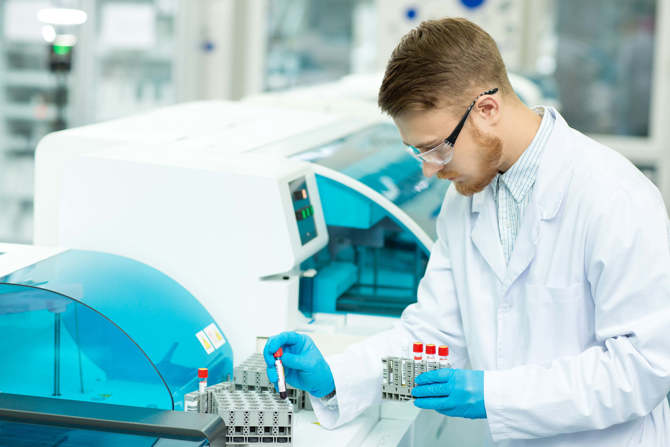
The dangers of insufficient supply
- Cryogenic liquids such as liquid helium can evaporate more rapidly, leading to increased operational costs and more frequent refills.
- Instrument performance and stability may be compromised, increasing the risk of unplanned downtime, data loss, or even equipment damage due to thermal stress or overheating.
- Cryogenic grinding, low‑temperature milling, and other cold‑dependent prep workflows may halt, disrupting sample preparation pipelines in pharma, materials science, and metabolomics labs.
- Background noise and thermal drift may increase in sensitive analytical systems (e.g., mass spectrometers, SQUID devices, optical cryostats), degrading data quality and forcing reruns.
What is magnet quenching?
Magnet quenching occurs when part or all of a superconducting coil transitions from a superconducting to a resistive state.
This can be triggered by:
- Inadequate cooling or temperature fluctuations
- Mechanical disturbances
- Power failures
- Sudden helium loss
When a quench happens, the magnet rapidly heats, releasing stored magnetic energy and potentially boiling off hundreds to thousands of litres of liquid helium within minutes—posing serious safety and equipment risks.
Noblegen’s solution: Autonomous, on-demand LN₂ generation
With over 30 years of experience, Noblegen Cryogenics is a trusted manufacturer of liquid nitrogen generators, supporting a wide range of research applications across global markets.
Noblegen’s systems combine advanced nitrogen generation with state-of-the-art cryogenic cooling technology, delivering a dependable and efficient on-site LN₂ supply. Developed by a team with deep technical expertise and a proven track record of successful deployments, these generators are engineered for long-term reliability and performance in any environment.
|
How do Noblegen generators work? |
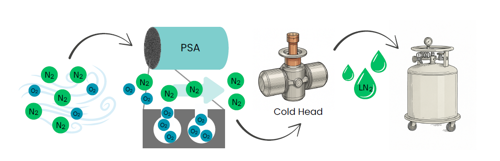
1 - Air Intake: Ambient air is filtered and compressed.
|
|
2 - Air Separation: Using PSA (Pressure Swing Adsorption) or membrane technology, nitrogen is separated from oxygen and other gases. |
|
|
3 - Purification: Trace impurities are removed. |
|
|
4 - Cryogenic Cooling: Cryocoolers cool nitrogen gas to −196 °C, liquefying it. |
|
|
5 - Storage: Liquid nitrogen is stored in vacuum-insulated dewars or tanks.
|
Global service and support network
Noblegen provides factory-trained service engineers who provide fast, reliable technical support to ensure uninterrupted research operations.
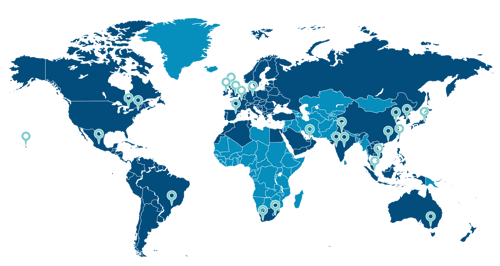
- · Noblegen is supported by the wider PEAK International Group’s service footprint, with operations in 25+ countries and service centers in 20+ countries.
- Our dedicated local teams address regional logistical challenges, offering proactive maintenance plans to keep your systems performing at their best.
- Exclusive use of manufacturer-approved parts for consistent, long-term reliability.
Why choose a Noblegen generator?
Noblegen provides three unique liquid nitrogen generator series: the Triton systems, designed for compact use with a daily production of up to 20 litres; the Callisto range, offering a mid-range capacity of up to 60 litres per day; and the Titan skid-based units, built for high-demand applications, capable of generating up to 800 litres of liquid nitrogen per day.
Triton
The Triton series offers a compact, efficient, and low-noise plug-and-play liquid nitrogen solution ideal for NMR applications. Its small footprint and easy operation make it well-suited for laboratories and research environments with limited space or infrastructure.
Callisto
The Callisto range provides reliable, high-efficiency on-site liquid nitrogen generation with increased production and storage capacity via its dual-cabinet design. Ideal for NMR facilities requiring greater LN₂ volumes, it combines a compact footprint, enhanced safety features, and increased volume, making it a practical and scalable solution for research environments.
Titan
Built for the most demanding applications, the Titan series comprises highly flexible and dependable on-site liquid nitrogen generators with a skid-mounted design. Producing up to 800L/day, Titan units can support a wide variety of applications from animal husbandry to research centers, universities, and cryocooling applications.
Nitrogen supply: A small detail with a big impact
Research laboratories with thermal management needs require a dependable and uninterrupted supply of liquid nitrogen to maintain instrument performance, protect sensitive equipment, and ensure research continuity. Traditional bulk LN₂ delivery systems expose labs to risks such as supply chain disruptions, evaporation losses, and safety concerns.
By adopting Noblegen’s on-site LN₂ generation systems, researchers can benefit from:
- Continuous, on-demand liquid nitrogen supply
- Improved laboratory safety and autonomy
- Reduced operational and logistical costs
- Lower environmental impact and carbon footprint.
Ready to make the switch?
Contact our team today to learn how Noblegen’s advanced liquid nitrogen generators can transform your research applications.