


Users of cryogenic technologies are familiar with boil-off gas (BOG) losses. Despite high-grade insulation, external heat always infiltrates cryogenic tanks and dewars, raising the temperature of cryogenic liquids - such as liquid nitrogen- and causing it to evaporate.
In cryogenic applications, BOG describes nitrogen, oxygen, argon, or other cryogenic liquids evaporating due to heat intrusion. In this article, we're focusing on liquid nitrogen, but the term is also widely used in the liquefied natural gas (LNG) industry to describe methane evaporation during storage or transport.
Key aspects of boil-off gas (BOG)
- Boil-off occurs due to heat ingress through insulation, external temperature changes, and agitation during transport.
- Failure to manage BOG can lead to over-pressurization of tanks, potentially resulting in equipment strain and even structural damage without sufficient venting.
- Boil-Off Rate (BOR): This measures the daily percentage of liquid converted to gas. It varies and can range from 1% to several % per day for smaller or aging dewars, while for larger vessels and tanks with superior insulation can be as low as 0.5%.
Liquid nitrogen boil-off during delivery
During the traditional liquid nitrogen delivery process, boil-off losses are inevitable.
Boil-off begins at the central supplier facility, where ambient heat causes the ultra-cold substance to evaporate. From the central ASU to road transit, during transportation, heat ingress and the liquid circulating in the tank causes it to further evaporate continuously, reducing the volume that reaches the customer.
Once the supply has reached the customers site, decanting causes further losses due to handling and pressure equalisation. Liquid will continue to evaporate in on-site storage, especially if the dewars or tanks are not insulated properly or are damaged.
As liquid nitrogen is distrubuted through pipework, pressure regulation introduces more losses, resulting in poor efficiency.
Ultimately, although losses occur across production, transport, and delivery stages, the customer pays for all the liquid lost during the process.
Reducing loss with on-site LN2 generation
The only practical way to minimize delivery‑related boil‑off is to eliminate deliveries altogether.
By generating liquid nitrogen at the point of use:
- Transport and transfer losses are removed
- On‑site storage can be smaller and more efficient
- Liquid is consumed immediately, rather than stored for long periods
- Costs become predictable and independent of supply-chain inefficiencies
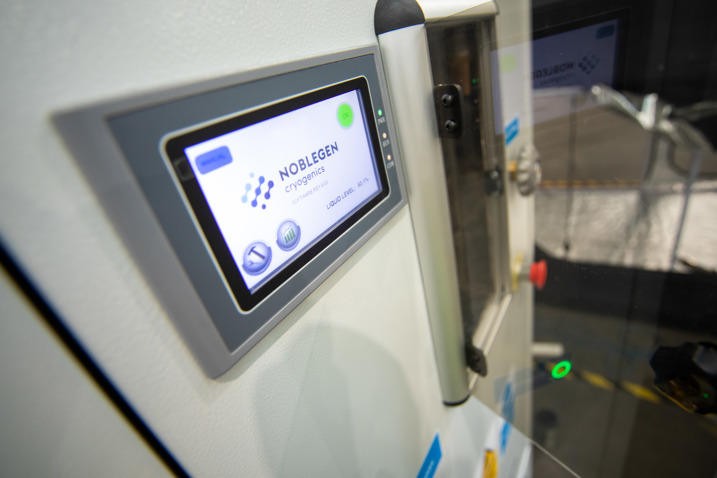
Noblegen's on‑site liquid nitrogen generators provide a continuous, demand‑based supply, drastically reducing waste and improving process control. Our larger models eliminate boil-off loss with a no loss pressure system that captures and reliquefies boil-off before it could be vented to the atmosphere.
5 practical steps for boil-off reduction
1. Invest in an on‑site generator
This is the single most effective method for eliminating supply‑chain losses that happen throughout the delivery cycle. Find out more about the benefits of on-site generation here.
2. Regular servicing
Routine maintenance of generators and associated equipment like dewars ensures optimal performance, minimizes downtime, and reduces unexpected failures that can lead to excess evaporation.
3. System redundancy
Incorporate backup components, such as secondary compressors, pumps, or control systems, so operations continue smoothly even if a single subsystem requires maintenance. This prevents unplanned venting or tank warming events.
4. Optimize storage
To optimize your storage vessels, make sure to use well‑insulated dewars or vacuum‑jacketed tanks. Minimize unnecessary lid openings and only open vessels when necessary. Place any liquid nitrogen storage away from heat sources or sunlight, and inspect seals, valves, and insulation regularly.
5. Improve transfer efficiency
Use vacuum‑insulated pipework and reduce transfer distance wherever possible. Maintain proper pressure regulation settings and avoid unnecessary transfers between containers or applications.
Conclusion
Boil‑off gas is an inevitable part of working with cryogenic liquids, but it doesn’t have to be excessively costly. Understanding where losses occur, and investing in the right technologies can significantly reduce waste, improve safety, and lower operating expenses.
For organizations that rely heavily on liquid nitrogen, on‑site generation is the most effective long‑term solution to minimizing boil‑off and ensuring a consistent, efficient supply.