


What is Assisted Reproductive Technology (ART)?
Assisted Reproductive Technology (ART) refers to human or animal fertility treatments that involve handling of eggs, sperm, or embryos in a laboratory to help with conception. Common ART methods for animals include artificial insemination, embryo transfer, and cloning. In this article, we'll focus on artificial insemination technology in agricultural, companion, and conservation contexts, used to improve livestock, create offspring from valuable animals, and aid in the survival of endangered species.
Assisted Reproductive Technology applications
Assisted Reproductive Technology (ART) refers to a range of advanced techniques used to aid reproduction in animals. It goes beyond Artificial Insemination (AI), which is a relatively simple and common method of introducing semen into the female reproductive tract during the fertile period. While AI is widely used for livestock breeding, ART also encompasses more complex procedures, such as in vitro fertilization (IVF), embryo transfer, and cryopreservation of embryos, allowing for greater control over genetic selection and reproduction. ART is often used for:
- Genetic Improvement
ART enables faster and more precise genetic selection in livestock by producing more offspring from genetically superior individuals.
- Infertility Treatment
ART can help infertile or subfertile animals reproduce successfully.
- Conservation
ART plays a vital role in preserving endangered species by creating offspring from valuable or rare individuals and boosting populations through assisted breeding programs.
- Research
These techniques allow scientists to study embryo development and reproductive biology in greater detail.
Cryopreservation in conservation
Genetic conservation acts as a vital safety net for future breeding programs and the genetic rescue of species. Cryogenic facilities (gene banks) vary in size, but all maintain critical databases and resources.
The primary purpose of cryopreservation is to safeguard threatened and indigenous breeds, which face numerous challenges such as urbanization, disease outbreaks, natural disasters, inbreeding, and climate change. Preserving endangered species is crucial because it prevents the irreversible loss of unique genetic traits, supports biodiversity, and ensures resilience in food production systems for future generations.
Additionally, cryoconservation safeguards genetic diversity and traditional livelihoods while promoting food security and sustainability. Indigenous livestock often possess traits such as disease resistance, heat tolerance, and adaptability to harsh environments. These characteristics are invaluable for breeding programs aimed at improving resilience in major livestock breeds. Furthermore, indigenous breeds contribute to local economies by utilizing marginal lands unsuitable for crops, producing meat, milk, hides, and manure, and even supporting cultural tourism. By maintaining these breeds, communities preserve cultural heritage and create sustainable income sources.
Artificial Insemination process
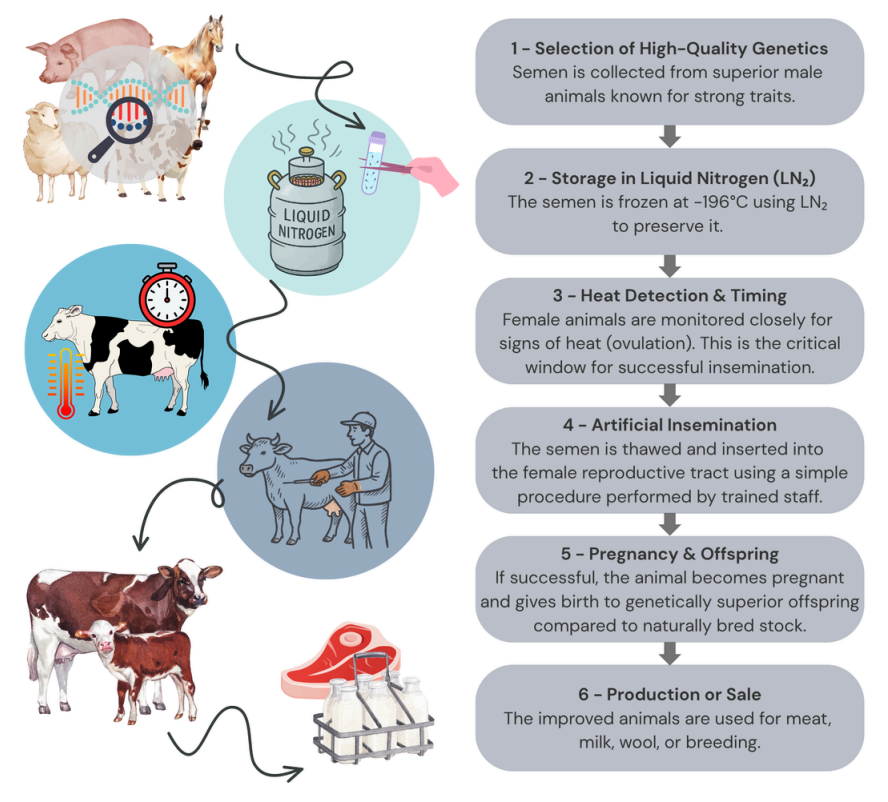
The diagram below illustrates the standard steps involved in artificial insemination. First, semen is collected from superior male animals selected for their desirable genetic traits. The sample is then frozen in liquid nitrogen for preservation, stored, and transported to the point of use.
Meanwhile, female animals are closely monitored for signs of heat (ovulation), as this is the optimal time for insemination. This fertile window typically lasts less than 24 hours, making timely intervention by trained personnel essential. When performed correctly, artificial insemination results in offspring with enhanced genetic quality compared to those produced through natural breeding.
How is liquid nitrogen used in ART?
The ultra-low temperature stops cellular activity and prevents ice crystal formation (when combined with cryoprotectants). This way, samples can remain viable for decades without degradation. Global transport for artificial insemination is also made possible using liquid nitrogen, allowing safe shipment of genetic resources worldwide. Farmers, agricultural co-ops, veterinary technicians, artificial insemination service providers, government agricultural departments, NGOs, and commercial breeding centers all rely on a steady supply of LN₂ to deliver consistent and effective reproductive services, without which, livestock improvement efforts may be delayed.
Challenges and considerations
Despite its advantages, cryopreservation using liquid nitrogen presents some challenges. Handling LN₂ requires strict safety protocols to prevent cold burns and asphyxiation risks. Additionally, maintaining cryogenic storage facilities involves significant technical expertise.
Biological samples must be carefully prepared with cryoprotectants to avoid ice crystal formation, which can damage cells during freezing and thawing.
Risks of unreliable liquid nitrogen supply
- Missed fertility windows
Delays in LN2 access can prevent insemination during very short and critical ovulation periods, reducing herd productivity. A missed cycle means a missed opportunity that might only occur weeks later. - Wasted investment
High-quality semen is costly; compromised samples due to poor LN2 supply result in financial losses. - Reduced fertility rate
Temperature variations or long transport can damage semen, lowering conception success and increasing operational costs. - Increased reliance on inferior stock
Without reliable LN2, breeders may use local or genetically weaker animals, raising inbreeding risks and lowering herd resilience.

The future of ART in animal husbandry
The future of cryopreservation in animal husbandry lies in integrated advanced technologies that help minimize cellular damage. Genomic tools combined with cryogenic storage will continue to enable precision breeding and conservation strategies. Automation and AI-driven monitoring will enhance the safety and efficiency of cryogenic banks, supporting global efforts in livestock improvement and biodiversity preservation.
Which LN2 generator is right for an ART application?
Choosing the right generator depends on factors such as usage requirements, available space, and frequency of operation. For most applications, on-site liquid nitrogen generation offers a safe, sustainable, and reliable alternative to traditional delivery methods.
Noblegen’s LN2 generators are designed for minimum vibration and semaless integration with other systems.
-
Triton Range
A compact, single-cabinet solution delivering 5–20 L/day for applications requiring smaller quantities. Equipped with a safe hose or flask dispense system, Triton units provide a high-performance, cost-effective alternative to deliveries. -
Callisto Range
Housed in a dual-cabinet design, Callisto units deliver 40–60 L/day for higher-volume applications. With large internal storage and continuous production capability, they ensure uninterrupted supply; ideal for frequent use and critical preservation needs.
By guaranteeing a consistent and dependable source of liquid nitrogen, Noblegen generators support safe and efficient ART and AI practices, helping maintain genetic improvement programs without the risk of supply disruptions. All models ensure consistent genetic improvement by supporting safe, efficient artificial insemination practices without the risk of supply issues.
For more information, do not hesitate to contact us:
Web - Visit the Contact page
Call us on - +44 (0) 191 460 1177