


How is nitrogen used in the aerospace industry?
Nitrogen plays a vital role throughout the aerospace industry, supporting a wide range of applications across aircraft manufacturing, maintenance, testing, and day-to-day flight operations. As safety remains the industry's highest priority, access to a dependable nitrogen supply is essential for ensuring operational reliability, protecting personnel, and maintaining compliance within the strictest aviation standards.
Thanks to its inert, non-reactive properties, nitrogen gas is widely used in applications where the presence of oxygen or moisture could compromise safety or performance.
Liquid nitrogen also plays an important role in aerospace testing and manufacturing. Its extremely low temperature makes it ideal for material testing, environmental simulation, thermal cycling, and precision assembly processes (such as cryogenic shrink fitting). These applications help manufacturers and maintenance teams verify component performance under the extreme conditions experienced during flight and ensure the long-term reliability of critical aircraft systems.
Because many of these processes are mission-critical, any interruption to the nitrogen supply can result in operational delays, disrupted testing programmes, increased costs, or potential safety concerns. As a result, aviation organisations increasingly view reliable nitrogen generation and supply as an essential part of maintaining safe and uninterrupted operations.
Liquid nitrogen in aviation
The aviation industry uses liquid nitrogen for the testing of components, including applications in material testing, shrink fitting, and thermal management.

Low-temperature testing: Essential for safety
Cryogenic liquid nitrogen is used in material testing to cool metals and composites to determine how these components work under extreme conditions, and to evaluate their mechanical properties and structural integrity. Key testing methods vary from being submerged in a liquid nitrogen bath to low-temperature chambers, which, in the case of testing aerospace components, are meant to replicate the extreme cold of high-altitude cruise conditions. Test specimens, small components, and mechanical parts are often submerged directly into a liquid nitrogen bath for steady-state low-temperature conditioning.
Some chambers cycle the temperatures between extreme hot and cold conditions in a controlled cycle to test material and seal integrity over time, and others combine low-temperature testing with reduced atmospheric pressure. These extreme swings happen thousands of times over an aircraft's lifetime, which is why aerospace material testing is so controlled and rigorous.
Liquid nitrogen in material testing can also be used indirectly, whereby it's sprayed or injected into the cooling circuit or air stream of the test chamber, or flows through internal heat exchangers or cold plates without letting the nitrogen mix directly with the testing space.
A reliable liquid nitrogen source ensures precise temperature maintenance, while preventing any LN2 supply issues from interrupting the process, leading to invalid data and financial losses.
Shrink fitting for precise assembly
Submerging metal parts in liquid nitrogen is a technique used in precision assembly. During cryogenic shrink fitting, the "inner" part of a component (like a steel bushing or shaft) is cooled to extremely low temperatures of -196 °C, which causes the metal to shrink by several microns, allowing it to be fitted into the "outer" part. Once it returns into room temperature (normally within seconds, which is why rapid installation is crucial), it expands and forms a tight 360-degree interference fit.
Key aviation applications of shrink fitted parts include landing gear assemblies, bushing and bearing replacements, and hydraulic and valve repairs. This method creates a pure friction-locked joint that handles extreme pressure and high-vibration flight environments better than those using adhesives or fasteners.
Gaseous nitrogen in aviation
Nitrogen gas, due to its inert and non-flammable qualities, is used in aviation for inerting, tire inflation, system purging and blanketing applications.
Fuel tank inerting
One of the most important aviation applications for nitrogen is fuel tank inerting. Nitrogen-enriched air is pumped into fuel tanks to displace oxygen, significantly reducing the risk of fire or explosions.
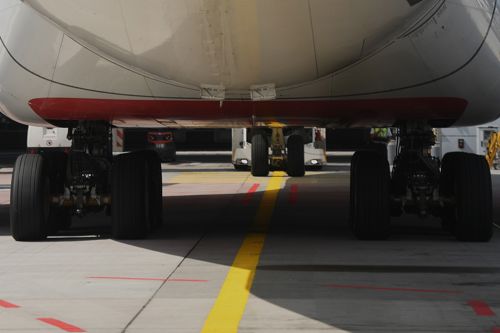
Aircraft tire inflation
Replacing regular compressed air with nitrogen helps reduce rubber oxidation, wheel corrosion, and fire risks caused by brake heat during landings. It also ensures stable pressure across high altitudes and the extreme temperature fluctuations that aircrafts go through.
System purging and blanketing
Nitrogen is routinely used to flush volatile vapors from engine turbine areas, purges oxygen systems, and blanket hydraulic accumulators and oil compartments against combustion.
How do nitrogen generators work?
Traditionally, aerospace applications have long relied on delivered cylinders, liquid nitrogen dewars, or bulk tanks. However, many organizations are turning to on-site nitrogen generation to improve supply security and reduce operating costs.
On-demand nitrogen generators are extremely efficient as they produce nitrogen directly from air, providing a continuous and high-purity supply of nitrogen gas (which can also be liquefied if the applications requires liquid nitrogen). Generating nitrogen on-site eliminates the need for scheduling deliveries, reduces transport and rental costs, and provides user with a dependable supply whenever and wherever it's required.
A complete nitrogen solution for aviation
As part of the PEAK International Group, Noblegen Cryogenics combines innovative liquid nitrogen generation technology with the Group's long-standing expertise in on-site gas generation. Through PEAK Gas Generation and the i-Flow industrial nitrogen generator range, PEAK has extensive experience supplying reliable nitrogen solutions across a wide range of industries. Together, the Group's gaseous and liquid nitrogen technologies provide aviation organisations with a complete on-site nitrogen solution, reducing dependence on delivered gas while improving supply security, operational efficiency and business continuity.
On-site nitrogen gas generation with i-Flow
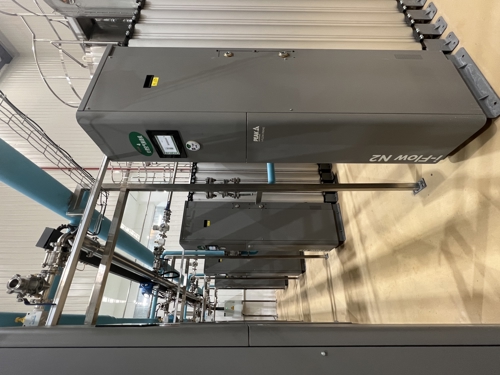
The i-Flow nitrogen generator produces high-purity nitrogen gas directly from compressed air using Pressure Swing Adsorption (PSA) technology. This provides a continuous and reliable source of nitrogen for applications such as:
- Fuel tank inerting
- System purging and blanketing
- Leak testing
- Manufacturing and maintenance operations.
By generating nitrogen on demand, aviation operators can eliminate cylinder handling, reduce delivery costs, and ensure a dependable supply of nitrogen whenever it is needed.
Liquid nitrogen generators by Noblegen Cryogenics
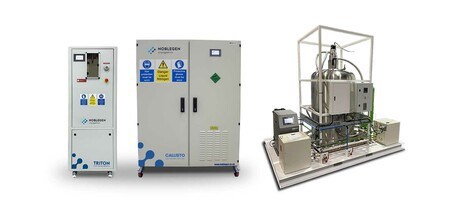
For applications that require cryogenic temperatures, Noblegen liquid nitrogen generators produce liquid nitrogen directly at the point of use from compressed air.
On-site LN2 generation is particularly suited to aerospace applications including:
- Low-temperature material testing
- Environmental and thermal cycling chambers
- Component qualification testing
- Cryogenic shrink fitting and assembly
- Research and development activities.
Producing liquid nitrogen on-site removes reliance on bulk liquid deliveries and helps prevent supply interruptions that could delay testing programmes or maintenance schedules. Noblegen's range covers applications requiring 5-800L+ of liquid nitrogen a day, providing an on-demand supply whenever and wherever it's required.
Get in touch with us for more information
Get in touch with our team to learn how on-site nitrogen gas and liquid nitrogen generation can support aviation applications. Backed by PEAK's decades of gas generation expertise, our generators deliver reliable, on-demand nitrogen solutions that help reduce reliance on deliveries, improve supply security, and support critical applications across the globe.